
How B2B Marketers Can Actually Use AI Effectively: With Examples
Real AI ROI has less to do with cutting cost and time, and everything to do with making the actual work better.
Most B2B marketers have tried AI. Fewer have got real value out of it. Ask around and you'll hear the same story: someone tried ChatGPT for a campaign brief, got something generic back, and quietly went back to writing it themselves. Most of the time, that comes down to how AI was set up, not the AI itself.
The frustration shows up in the data. The martech landscape now runs to roughly 15,500 tools, per chiefmartec's 2026 census, and the average enterprise stack contains around 91 of them, most sitting unused. Access to tools was never the constraint. One survey of 371 marketing leaders found that just 5% of B2B respondents said AI is exceeding ROI expectations, compared with 31% at B2C and hybrid companies; 72% of B2B respondents said it's delivering only limited or no ROI at all.
The gap between marketers who get real value from AI and those who don't comes down to three things: how much relevant context the system has access to, and whether it's being used to challenge thinking or just confirm it. It also comes down to whether output is checked against a real standard before it goes anywhere near a client. Get those three right and AI starts doing work that holds up. Skip them and you get exactly what you'd expect: plausible-sounding, forgettable content that needs rewriting anyway.
Here's how we think about all of this at Bordeaux & Burgundy, with concrete examples of what's working, how we built it, and where we think AI still falls flat.
Context Build: Why Most AI Use Fails Before It Starts
Every business already holds a huge amount of intelligence. It's in Slack threads where someone explained a client's real objection. It's in the CRM notes from a call three months ago. It's in the reporting dashboard nobody checks unless there's a fire. It's in the Google Doc where a strategy actually got hashed out, not the polished deck that came after it.
Most of that intelligence sits disconnected from any AI system, which means every time someone opens a chat window, they're starting from zero. They have to manually copy-paste the client brief, the brand guidelines, the last three months of performance data, and the relevant Slack conversation just to get the model to a baseline understanding. Most people don't bother, so they get a generic answer and conclude 'AI doesn't really work for this.'
That's not a fluke. Gartner's 2024 CMO Spend Survey found that 40% of AI marketing initiatives fail to meet their stated year-one ROI target. The figure drops to 22% when the team has agreed clear success criteria upfront. The same pattern holds here as with context: initiatives that go in with a proper framework do markedly better than ones that don't.
The fix here comes from giving the AI standing access to the same information your team already has, so it isn't reasoning from nothing every time, not from writing a better prompt. This is the difference between asking a new hire on their first day to write a client strategy versus asking someone who's been embedded in the account for a year. Same intelligence, wildly different output, purely because of what they know going in.
Internal System: Margeaux
We built this out properly rather than leaving it to individual habit. We connected our AI system to every relevant context location across the business: Notion for project docs and strategy notes, and Slack for the day-to-day conversation where most real information actually lives. We also connected our reporting dashboards for live client performance data, and Google Drive for briefs, decks, and creative assets. On top of that, we layered skill files and specific instructions covering how we work, what our standards are, and how to interpret the data it has access to.
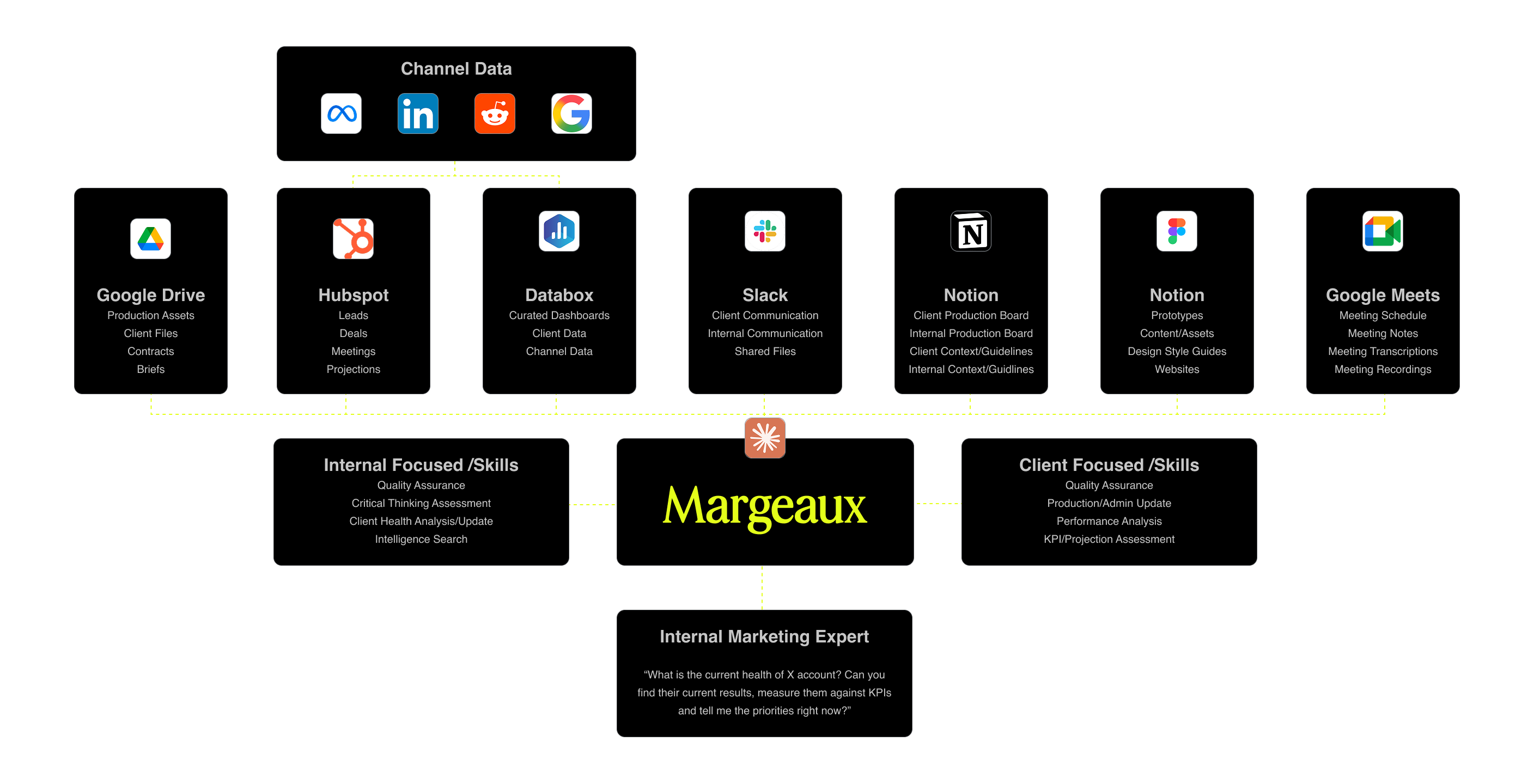
We named the system Margeaux. In practice, it functions as a shared brain that any team member can query directly.
That means a project manager can ask 'what's the current status of the Chateau Laurent campaign' and get an answer pulled from the actual Slack thread where the last update was posted, cross-referenced against the reporting dashboard. No more pinging three people and waiting for replies. It also means someone picking up an account for the first time (covering for a colleague on holiday, say) can ask Margeaux for a full brief on where things stand, what's been agreed, and what's outstanding. The answer comes back in seconds, not after a scramble through old emails.
The organisation's own knowledge becomes queryable and current here, instead of staying trapped in whichever tool it happened to be written in, or with whichever person happened to be paying attention that week. That's the real value, not the novelty of having an internal AI tool.
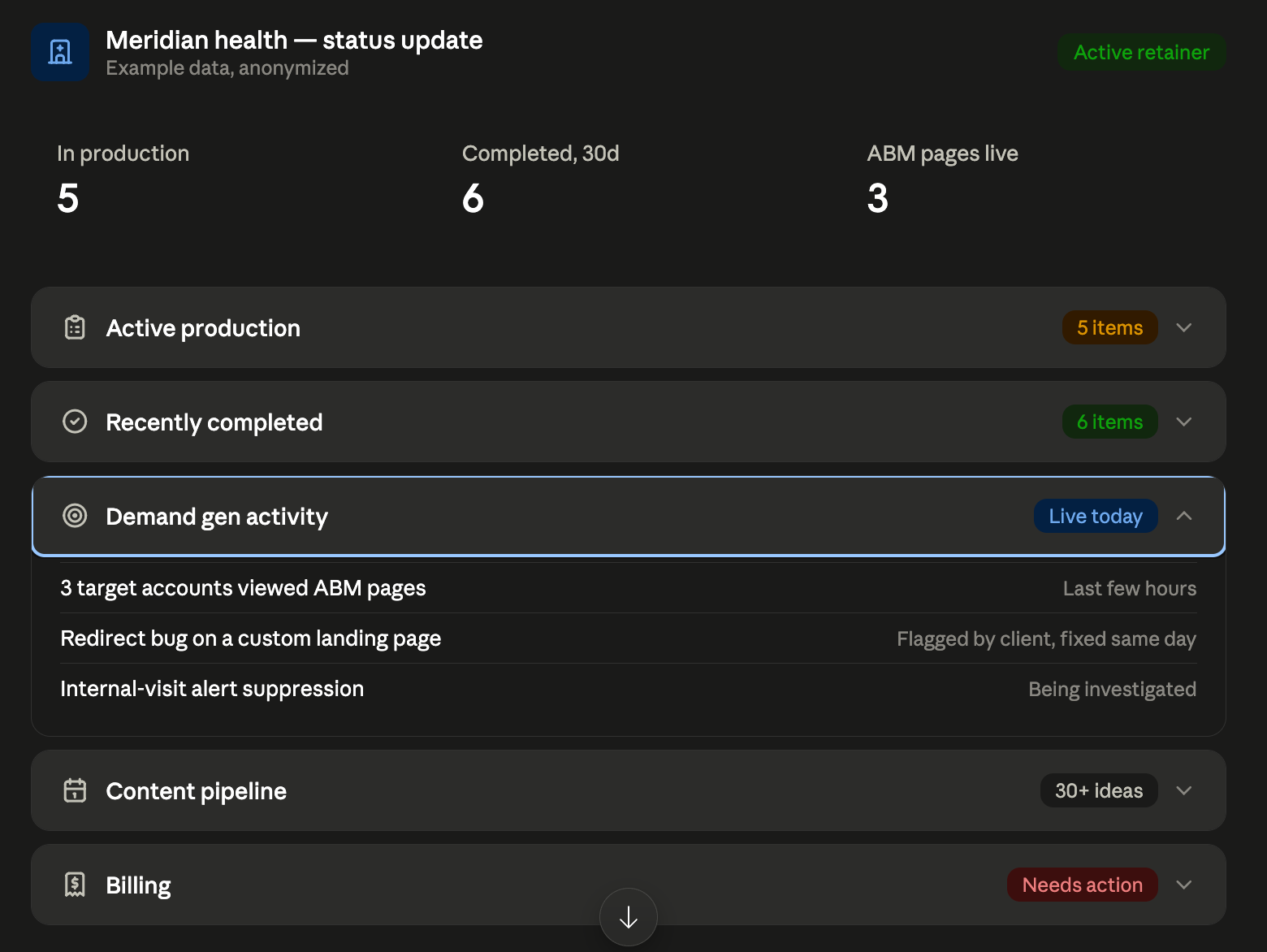
This has been anonymized and changed slightly for privacy purposes
Critical Drafting: Using AI to Argue With You, Not Agree With You
Left to its own devices, AI tends to be agreeable. Ask it to review a piece of work and, by default, it will find something nice to say and confirm the general direction is sound. That's the least useful thing it can do for you, because it's exactly what you'd get from a colleague who hasn't really engaged with the work either.
The more useful move is forcing it to criticise. Not 'does this look good' but 'what's the weakest part of this argument,' 'what would a sceptical procurement lead say about this pricing section,' 'where does this deck contradict itself,' or 'argue the opposite position as convincingly as you can.' That reframing changes the entire value of the exercise. Instead of a rubber stamp, you get a genuine stress test, and stress-tested work is what actually survives contact with a client, a board, or a competitor's counter-pitch.
This works especially well for strategy documents and campaign concepts, where the real risk is a flawed premise nobody caught, not a grammar slip or a polish issue, because everyone in the room had already bought into it. Asking AI to take an adversarial pass, deliberately looking for the flaw rather than the merit, surfaces exactly the kind of gap that groupthink misses. It's also useful for creative concepts: asking 'what's the most predictable, least original interpretation of this brief' is a fast way to identify what to avoid, precisely because the model is good at generating the obvious version when you ask it to.
The instruction matters more than the tool here. A prompt that says 'review this' gets you agreement. A prompt that says 'find the three biggest weaknesses in this and argue against my own conclusion' gets you something worth acting on.
Quality Assurance: Our Highest-Value Use of AI
This is the single most useful way we've found to use AI at Bordeaux & Burgundy, and unlike the internal-tool example above, it's something any company can set up regardless of size or budget.
It's also where the industry data is starkest. Jasper's 2026 State of AI in Marketing report, based on 1,400 marketers, found that only 41% can now demonstrate AI ROI, down from 49% the year before. When asked what's actually blocking teams from scaling AI, the top answer was brand, legal, and compliance review, followed by output quality, not budget or skills. The bottleneck is exactly the gap a QA layer is built to close.
We built a Bordeaux & Burgundy QA skill file: a plain text document, nothing more complicated than that. It lays out our standards for content, ideas, marketing, communications, and everything else we consider essential to maintaining quality across our client base. It covers things like tone of voice rules and the kind of claims we will and won't make on a client's behalf. It also covers formatting and structural conventions, common mistakes we've flagged in past reviews, and the bar we hold creative concepts to before they go external.
Any team member can call this up at any point and check their work against it, simply by running /BBQA. It takes a piece of draft work (a piece of content, a strategy doc, an email to a client, a creative concept) and runs it against the full standard. It flags where it falls short and why, with specific reference to the relevant section of the skill file, rather than a vague 'this could be better.'
This turns 'does this feel right?' from a subjective, inconsistent judgement, depending on who happens to review the work and how much time they have, into a consistent, repeatable check against a standard the whole team agreed on and wrote down. None of that comes down to AI having good taste. A junior team member gets the same rigour of review as if a senior partner had looked at it personally, every single time, on demand, without waiting for anyone's calendar to free up.
It also compounds. Every time we catch a recurring mistake or refine a standard, it goes into the skill file, and every future check benefits from it. The QA bar goes up over time instead of depending on whoever happens to be reviewing that week.
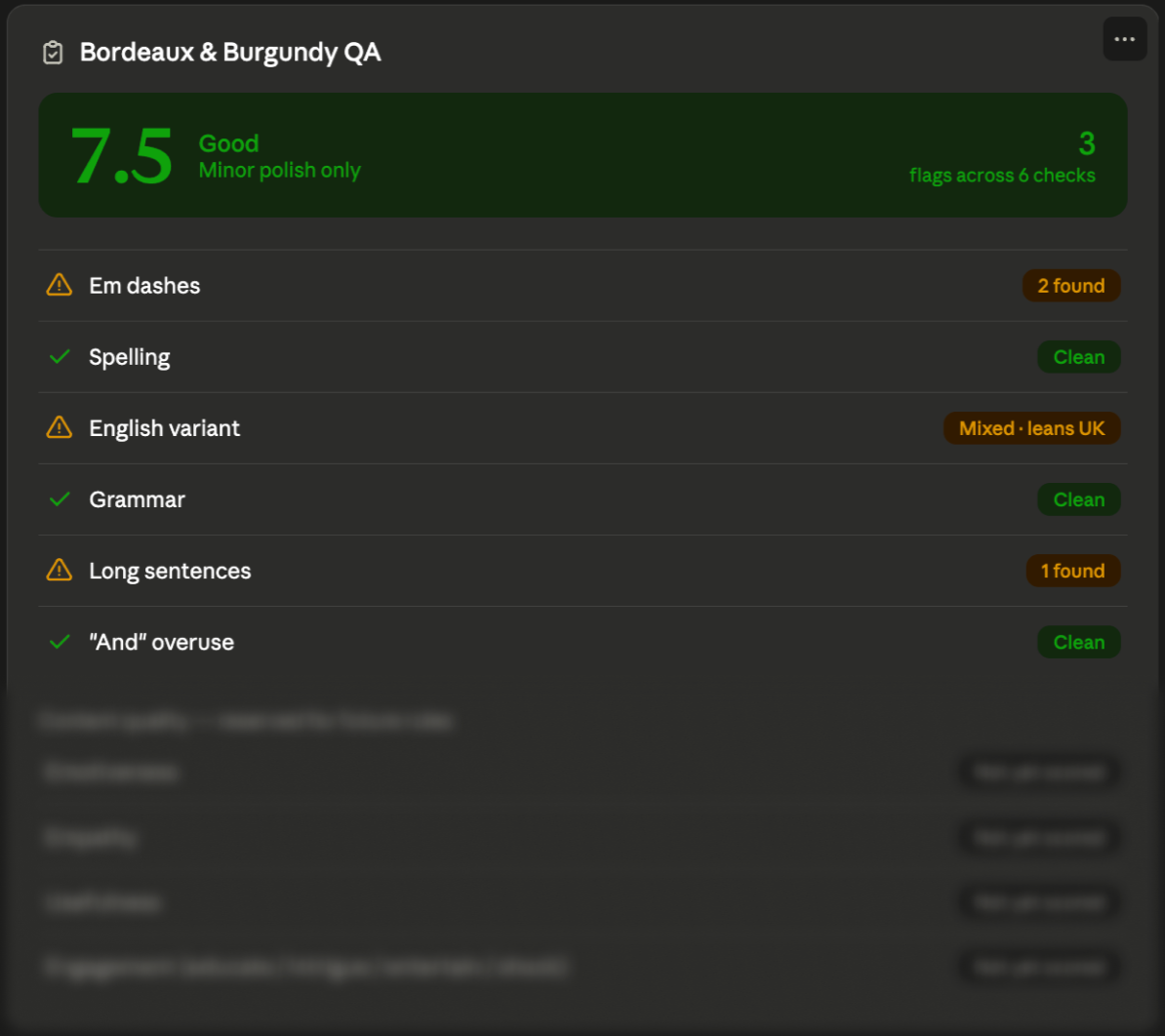
We've hidden some of our secret sauce to great copywriting.
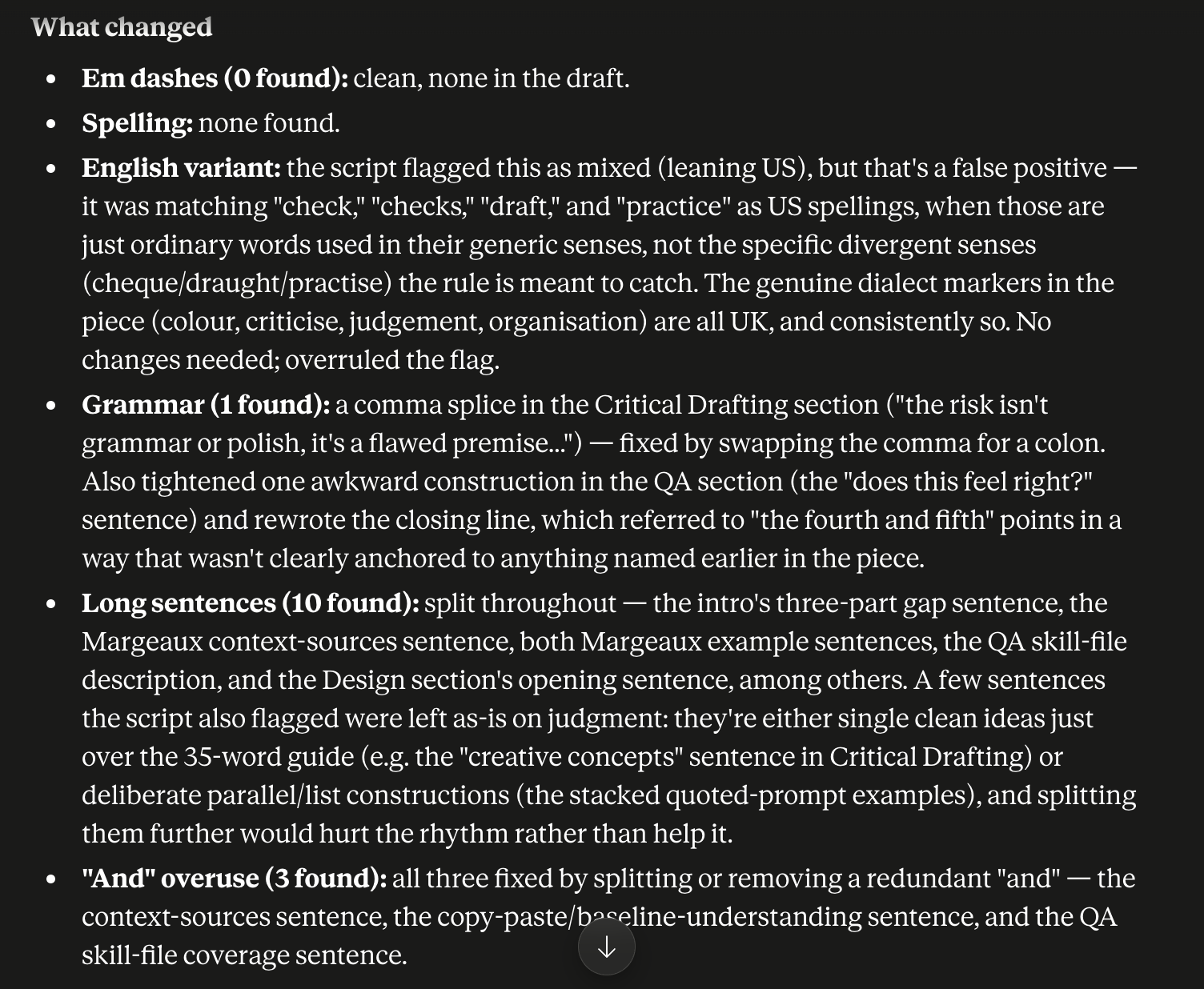
Once you review, the QA can automatically make changes for you and highlight exactly what was changed and where - here's the example of this very piece.
Where We Think AI Doesn't Win
It's worth being just as clear about where this doesn't work, because the failure mode of over-applying AI is as costly as under-applying it.
Design. Despite a lot of hype, AI-generated design is still incredibly limited. It can produce something that looks plausible in isolation (a clean layout, an on-trend colour palette, a passable icon set). But it consistently misses the things that actually matter: consistency with existing brand equity, and the judgement to know when a rule should be broken deliberately. What's still missing is the kind of craft that comes from a designer who understands the client's audience, not just the client's brief. That's why we don't use AI to originate creative concepts or brand-defining design work. Where it does earn its place is in the mechanical layer around that work: resizing an approved asset across the full set of ad formats and placements, and generating variations of an existing creative for testing. It also handles some of the animation elements once the core concept is locked. That's execution, not judgement, and it's exactly the kind of work AI is well suited to.
High volume, low thought: 'prompt and publish.' The temptation with AI is scale: generate ten blog posts, fifty social captions, a hundred ad variants, with minimal human input at any stage. This produces exactly what it sounds like: generic, forgettable content that reads like it was written to satisfy a content calendar rather than a reader. Volume without context, without critical review, and without a quality check is a liability, not a shortcut, because it puts a client's name on something nobody actually stood behind. Every one of the three practices above (context, critique, QA) takes time. Skipping them to hit volume defeats the purpose.
The Takeaway
Most people measure AI ROI by cost and speed: hours saved, cheaper output, faster turnaround. That's uninspired, narrow-view thinking. It caps AI's value at whatever a spreadsheet already knows how to count, and it misses the far bigger opportunity: making the actual product or service better.
Context, critique, and QA are simply the three examples that happen to work at Bordeaux & Burgundy: three answers to that bigger question, not a checklist or a set of steps to copy. Pulling instant context makes the work smarter. Forcing AI to argue with your thinking makes the work sharper. Holding everything to a written standard makes the work more consistent. None of that shows up as a line item on a cost report, and all of it changes what a client actually receives.
Your own answers might look completely different: a different friction to remove, a different weak spot to argue with, a different standard worth holding. What won't change is the test behind them: does this make the actual work better, rather than just cheaper or quicker. Ask that harder question, and design shortcuts and content-mill volume stop looking tempting on their own, because you'll be too busy chasing the answer that actually moves the needle.
Sources: chiefmartec.com, 2026 Martech Landscape Census · Gartner CMO Spend Survey 2024 · Jasper, State of AI in Marketing 2026 (1,400 marketers) · Bordeaux & Burgundy internal data